
Tribes of Arunachal Pradesh: Complete Guide for APPSC, APPSB, UPSC & State Exam Aspirants
Target: APPSC/UPSC/State-service aspirants from Arunachal Pradesh
Dear Aspirants, This is your comprehensive, exam-oriented guide to the tribes of Arunachal Pradesh, crafted from the classroom perspective at NEPSC.
In this detailed primer, we will walk through the essential statistics, district-wise distribution, regional map references, and the cultural, social, and economic features you must master.
We will also cover the legal and constitutional context, including Scheduled Tribe recognition, recent amendments (such as the 2021 update), and administrative significance, all of which are potential goldmines for Paper-II, General Studies, and optional subject answers.
This guide is structured for quick revision and long-term retention:
- Fact capsules for Prelims for APPSC, APSSB and other Govt exams
- Analytical linkages for Mains
- Map pointers for geography-based questions
Model answer frameworks for descriptive writing
You’ll also find practice questions with answer outlines, ensuring you can apply knowledge effectively in a time-bound exam setting.
Whether you are targeting APPCS (CCE), UPSC, or other government service exams, this resource will help you internalise the complex tribal landscape of Arunachal Pradesh in an organised, memorable, and examination-ready format.
Quick snapshot (high-value facts you must memorize)
- Diversity: Arunachal Pradesh is home to around two dozen major tribal groups and over a hundred sub-tribes, a fact often tested in prelims and mains.
- Scheduled-Tribe majority: As per Census 2011, Scheduled Tribes form a large majority of the state’s population, roughly 68.8%. (Use this figure in answers where population structure is asked.)
- Largest single tribal groups: The Nyishi feature among the most numerous individual tribes (2011 census: ~2.5 lakh), while the Adi constitute one of the largest Tani clusters, useful when asked to compare tribal demography.
- Legal/constitutional hook: Arunachal has a state-specific provision : Article 371H, which gives the Governor special responsibility regarding law & order; this is a recurring mains topic when discussing autonomy and centre-state relations.
Culture & festivals (memorables): Major tribal festivals: Solung (Adi), Nyokum (Nyishi), Mopin (Galo), Losar (Monpa), are commonly asked in cultural sections. ( click to know about major festivals of Arunachal Pradesh.
Ethno-Linguistic Zones of Arunachal Pradesh, Visual Map Aid for Aspirants
When you picture Arunachal Pradesh for civil service map questions, think of its tribes arranged in broad east–west cultural belts. If you can mentally link 3–4 key districts with one major tribe each, you’ll recall them faster in the exam.
1. Western Arunachal Belt
Districts: Tawang, West Kameng, East Kameng, parts of Papum Pare
Major Tribes: Monpa, Aka, Sherdukpen, fringe Nyishi presence
Key Cultural Marker: Strong Buddhist influence in the Monpa region, especially Tawang monastery and related festivals.
(Source: Encyclopedia Britannica)
2. Central Arunachal Belt
Districts: Upper Subansiri, Lower Subansiri, West Siang, East Siang, Upper Siang
Major Tribes: Adi (Padam, Minyong sub-groups), Galo, Apatani
High-Value Fact: Ziro Valley in Lower Subansiri = Apatani homeland — frequently asked in Prelims and Mains geography sections.
3. Eastern Arunachal Belt
Districts: Lohit, Anjaw, Dibang Valley
Major Tribes: Mishmi groups — Idu Mishmi, Digaru Mishmi (also called Taraon), Miju Mishmi (also called Kaman); smaller Tai-Khampti presence in the Lohit valley.
Tip: Remember Mishmi: Eastern highland–frontier tribe, linked with the Indo–Myanmar–China border area.
4. Southeastern Arunachal Belt
Districts: Tirap, Changlang
Major Tribes: Wancho, Nocte, Tangsa, Singpho
Exam Angle: Often come up in questions on Naga-affiliated tribes and cross-border cultural exchanges with Myanmar.
(Source: Encyclopedia Britannica)
Exam Strategy:
Instead of memorising 100+ tribal names, anchor your memory with:
- 1 district → 1 flagship tribe → 1 cultural/linguistic cue
- Example: Lower Subansiri → Apatani → Ziro valley, wet-rice terrace
KEY TRIBES:
Nyishi Tribe
Key Facts for Aspirants
- Location & Distribution:
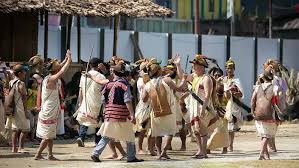
The Nyishi are predominantly settled in KurungKumey, Kra Daadi, East Kameng, West Kameng, Papum Pare, and adjoining areas. Their presence extends into parts of Lower Subansiri and Pakke-Kessang, making them one of the most geographically widespread tribes in Arunachal Pradesh. - Cultural Identity Markers:
Traditionally, Nyishi men wear a distinctive cane helmet decorated with the beak of a hornbill , a powerful symbol of bravery and status. Historically, their economy centred on jhum cultivation (shifting agriculture), supplemented by hunting and foraging. The NyokumYullo festival, celebrated in February, is a major socio-religious event dedicated to the deity of land and nature, reflecting their deep connection to agrarian life. - Exam Significance:
The Nyishi are often noted as the most populous single tribe in Arunachal Pradesh (Census 2011), making them highly relevant for questions on demography, culture, and political representation in state-level and national exams.
Apatani Tribe — Ziro Valley’s Cultural and Agricultural Heritage
- Location & Distribution:
The Apatani are exclusively associated with the Ziro Valley in Lower Subansiri district, a high-altitude plateau known for its scenic beauty and compact settlements. - Cultural & Economic Identity:
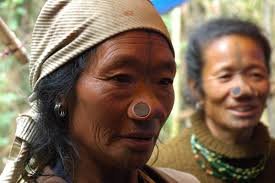
They are renowned for their innovative terraced wet-rice cultivation, which integrates paddy fields with fish farming, a sustainable practice unique to the Eastern Himalayas. Historically, Apatani women bore facial tattoos and wore large cane nose plugs, a tradition now discontinued but still iconic in ethnographic records. Their agricultural methods are recognised for ecological balance without the use of farm animals or machinery. - Exam Relevance:
The Ziro Valley is frequently mentioned in tourism, cultural heritage, and geography questions, with its agricultural system considered for UNESCO World Heritage status. The Apatanimodel is often cited in topics related to indigenous knowledge systems, sustainable farming, and rural development in Arunachal Pradesh.
Adi Tribe: Central Arunachal’s Tani Heritage
- Location & Distribution:
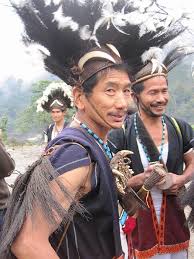
The Adi people, belonging to the Tani ethnolinguistic group, inhabit the central valleys and hill slopes of Arunachal Pradesh, primarily in Siang, East Siang, and Upper Siang districts, with smaller settlements extending into parts of Lower Dibang Valley. - Cultural & Social Identity:
The Adis are celebrated for their rich oral folklore and vibrant storytelling traditions, which preserve myths of origin, heroic epics, and moral codes. Their major festival, Solung, marks both harvest celebrations and seed-sowing rituals, blending agricultural life with spiritual offerings to deities and nature spirits. Social order is maintained through village councils, called Kebang (or Geran in some areas), which function as traditional forums for dispute resolution, governance, and community decision-making.
Exam Significance:
The Adi are one of the largest tribal groups in Arunachal Pradesh, making them a recurring feature in culture, polity, and ethnography questions. The combination of Tani lineage, structured self-governance, and agricultural festivals makes them a textbook example in both Anthropology optional and General Studies papers.